
How Much More Does a World Cup Weekend Cost Than a Normal Sports Weekend?
We compared WC match-weekend hotel rates against regular sports weekend rates in all 11 scored host cities. The tournament demand premium ranges from 33% in San Francisco to 118% in Houston.
Houston hotel premium
118%
New York hotel premium
49%
Avg cost multiple
2.0x
Cities compared
11
The Question
Every existing World Cup cost guide tells you what a trip costs. None of them tell you what that trip costs relative to a normal sports weekend in the same city. That matters, a $317/night hotel in Dallas sounds mid-range until you realize the same room goes for $155 on a regular Rangers weekend. You are paying a 105% tournament premium driven entirely by match-weekend demand.
We pulled median hotel rates from Booking.com for two scenarios across all 11 scored host cities: regular sports weekends (sampled year-round from the SportCation Index) and actual World Cup match weekends (sampled across all tournament dates per city). Same methodology, same 3km editorial radius, same 3-star preferred filter. The only variable is the date.
Data Sources
- Regular sports weekend hotel rates: Booking.com via SportCation Index (sampled March 2026, 4–10 properties per city)
- WC match-weekend hotel rates: Booking.com (sampled April 2026, 6–32 properties per city, all tournament weekends)
- Ticket pricing: FIFA official 2026 Category 2 minimum ($500 neutral, $1,100 host nation)
- Regular ticket benchmarks: SportCation Index median ticket prices by league
Key Findings
- 118%, Houston has the largest hotel premium (regular $208 → WC $454)
- 49%, New York has the lowest premium among high-cost markets (regular $346 → WC $517)
- $600, A Canada match ticket in Toronto costs $600 more than the same seat at a neutral match
- 2.0x, The unweighted average cost multiple across all 11 cities (sum of city multiples ÷ 11)
The Tournament Demand Premium by City
| City | Regular Hotel/Night | WC Hotel/Night | Premium | Regular Weekend Total | WC Weekend Total | Cost Multiple |
|---|---|---|---|---|---|---|
| Dallas | $155 | $317 | +105% | ~$610 | ~$1,474 | 2.4x |
| Houston | $208 | $454 | +118% | ~$816 | ~$1,694 | 2.1x |
| Kansas City | $281 | $574 | +104% | ~$862 | ~$1,848 | 2.1x |
| Miami | $243 | $392 | +61% | ~$786 | ~$1,524 | 1.9x |
| Atlanta | $151 | $242 | +60% | ~$602 | ~$1,184 | 2.0x |
| Toronto | $261 | $393 | +51% | ~$822 | ~$1,578 | 1.9x |
| New York | $346 | $517 | +49% | ~$1,092 | ~$1,924 | 1.8x |
| Boston | $405 | $654 | +62% | ~$1,210 | ~$2,008 | 1.7x |
| Seattle | $260 | $529 | +103% | ~$820 | ~$1,558 | 1.9x |
| Philadelphia | $258 | $451 | +75% | ~$816 | ~$1,502 | 1.8x |
| San Francisco | $182 | $242 | +33% | ~$664 | ~$1,184 | 1.8x |
Hotel rates are hard medians from Booking.com (regular: March 2026, 4–10 properties per city; WC: April 2026, 6–32 properties per city, match-weekend dates). Total-weekend estimates are modeled: 2-night hotel + estimated ticket + food + transit. Regular tickets use SportCation Index median prices by league ($150–$300), cities with more expensive leagues (NBA, NFL) have higher regular-weekend baselines than cities anchored to MLB or MLS. WC tickets use FIFA Cat 2 minimum ($500 neutral). Food and transit are city-adjusted estimates, not sampled. For full sourcing, see our city cost breakdowns.
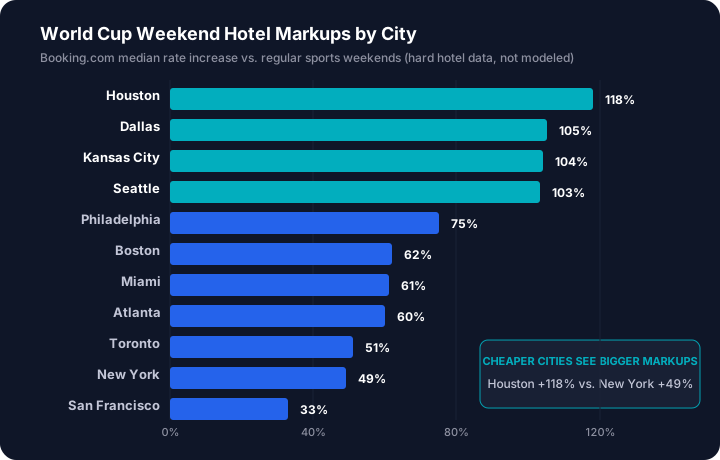
The four cities above 100% (teal) are markets where hotel rates more than double during WC weekends. The gap between Houston (118%) and San Francisco (33%) is the clearest signal that tournament demand hits smaller hotel markets hardest.
What the Numbers Reveal
The premium hits cheaper cities harder
Dallas, Houston, Kansas City, and Seattle all see hotel rates roughly double during WC weekends. These are markets where baseline lodging is affordable, $155 to $281 per night, so the tournament demand surge represents a proportionally larger hit.
New York, Boston, and Toronto already have expensive baselines ($261–$405/night), so the same demand pressure adds fewer percentage points. A $171 absolute increase on a $346 base (New York) is 49%. A $162 increase on a $155 base (Dallas) is 105%. The dollars are similar. The sticker shock is not.
Tickets are the great equalizer, except in Toronto
FIFA prices group-stage tickets uniformly at $500 (Category 2 minimum) regardless of venue. That means ticket cost does not vary between host cities the way it does for regular sports. An MLB ticket in Kansas City runs $40–$80. An NBA ticket in New York runs $150–$300. At face value, a World Cup ticket starts at $500 everywhere — though FIFA's dynamic pricing now moves the live price by demand.
The exception is Toronto. Canada's home match there is priced at $1,100 (Cat 2 minimum), more than double the neutral price. (Canada's other two group games are in Vancouver.) That single date makes a Toronto Canada-match weekend ($2,178) more expensive than a New York weekend ($1,924) despite lower hotel rates.
The cost multiple tells you more than the total
The multiples below are modeled estimates, they use the hard hotel medians but add estimated ticket, food, and transit costs. They are directionally useful, not precise to the dollar.
A World Cup weekend in Atlanta costs $1,184, the cheapest in the tournament. But a regular sports weekend in Atlanta costs roughly $602. You are still paying nearly 2x for the tournament premium.
Meanwhile, Boston's World Cup weekend at $2,008 is the most expensive, but relative to its already-high regular-weekend baseline ($1,210), the multiple is only 1.7x. Boston is expensive all the time. The World Cup makes it more expensive, but the jump is less dramatic.
The cities where the World Cup premium feels most dramatic are the ones where regular weekends are cheap. Dallas, Houston, and Kansas City are the biggest "sticker shock" markets, not because the absolute cost is highest, but because the gap between normal and tournament pricing is widest.
What This Means for Different Budget Bands
The modeled weekend totals (not the hard hotel data above) suggest rough tiers. Treat these as planning ranges, not precise forecasts, hotel medians are measured, but the totals layer in estimated tickets, food, and transit.
- Under $800 regular baseline: A World Cup weekend roughly doubles your spend. Atlanta and San Francisco ($1,184 modeled) are the cheapest tournament markets.
- $800–$1,000 regular baseline: Houston ($1,694) and Toronto neutral ($1,578) land in the 1.9–2.1x range. Toronto's transit advantage compresses non-hotel costs.
- $1,000+ regular baseline: New York ($1,924) carries a lower multiple (1.8x) because the baseline is already high, and 10 stackable weekends give you the most scheduling flexibility.
The full city-by-city cost breakdowns: New York | Toronto | Dallas
For the ranked comparison of all host cities: Every Host City, Ranked for Sports Fans
FAQ
Why is the cost multiple lower for expensive cities?
Because the baseline is already high. A $171 hotel increase on a $346 base (New York) produces a 49% premium. The same $162 increase on a $155 base (Dallas) produces a 105% premium. The absolute dollar increase is similar, the perception differs because of where you start.
Are these rates locked in, or will they change?
Hotel rates will continue to shift as the tournament approaches. The data here reflects Booking.com samples from April 2026. Once knockout brackets are announced, rates in the surviving host cities will spike further. Group-stage weekends that do not draw marquee matchups may soften. That is largely what happened: by early June 2026, reporting (ESPN, June 4) found the cheapest tickets across all 11 US host cities had fallen about 37% from their 60-day-out levels, and some hotel markets (notably Dallas) proved far more price-stable than the April projections. Book refundable rooms and revisit closer to the event.
What about Airbnb or alternative lodging?
This analysis uses hotel rates only (Booking.com, 3-star preferred). Airbnb and short-term rental rates follow a similar tournament demand curve, but the data is less standardized. In cities with strong Airbnb supply (Houston, Dallas, Atlanta), alternative lodging may compress the premium. In constrained markets (Toronto, Boston), the premium carries across both channels.
Why is Vancouver not in the table?
Vancouver hosts 7 World Cup matches and has the highest hotel premium of any host city (229%, from $179 to $588/night), but it has no MLB team. Since the WC weekend total estimate assumes a multi-sport stack including baseball, Vancouver is excluded from the comparison table. Its hotel spike is noted in the host city rankings.
Don't just watch, Go.
Plan a World Cup weekend in your budget
Filter cities by tournament-weekend cost premium and stackability.