
How to Plan a 2026 World Cup Trip Around More Than One Live Sports Event
A step-by-step decision framework for building a 2026 World Cup + MLB weekend trip: which city, which weekend, where to stay, what to book first, and what can break the plan.
Decision framework
6 Steps
Scored and compared
11 Cities
Budget to premium
3 Itineraries
WC + MLB verified
50 Combos
What This Guide Does
This is not another analysis of the data. The overlap analysis covers the dataset. The city rankings cover the comparisons.
This guide is a decision framework. It walks through six questions in the order you should answer them, from choosing a city to building a fallback plan. Each step ends with a concrete rule or threshold so you know when you have answered the question well enough to move on.
Step 1: Which City?
Decision question: Where should I fly?
Rule: Do not choose a city with fewer than 3 stackable weekends unless a specific match is the priority. Cities with 4+ weekends give you fallback options if schedules shift.
Open the overlap table and sort by the "Trips" column. The tiers:
- 10 weekends: New York, most flexibility, highest cost
- 5–6 weekends: Houston, Boston, Miami, Kansas City
- 4 weekends: Toronto, Los Angeles, the minimum for comfortable planning
- 2–3 weekends: San Francisco, Dallas, Seattle, Philadelphia, Atlanta, commit to a specific weekend
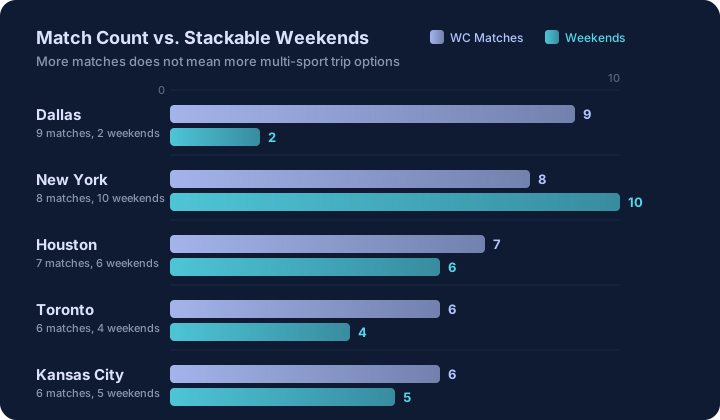
Do not pick by match count. The full city rankings show how each city scores across overlap, cost, and transit.
Step 2: Book Hotels Now, Everything Else Later
Decision question: What should I lock in today?
This is the highest-leverage action in the entire plan. WC match-weekend hotel rates have already spiked 50–120% above off-season, and they will climb further once knockout brackets are announced.
Hotels, book refundable rooms now. Lock in rates near the stadium district. You can always cancel. You cannot retroactively create inventory. Target locations:
- New York: Newark (near MetLife via NJ TRANSIT, $100–$150/night less than Manhattan)
- Houston: Energy Corridor or Midtown (METRORail access to both venues)
- Toronto: Bloor-Danforth subway line or Liberty Village (transit to BMO Field)
- Dallas: Arlington cluster (walking distance to both venues, limited inventory)
World Cup tickets, wait for official FIFA sales. Secondary-market prices are currently inflated because official supply has not fully released. Buying resale now means paying a scarcity premium that will partially deflate.
MLB tickets, buy 1–2 weeks before game day. Regular-season baseball in June and July is low-scarcity. Prices typically drop in the final 48 hours. Exception: rivalry series (Yankees-Red Sox, Dodgers-Giants).
Rule: If you cannot book a refundable hotel in your target city for under $500/night during your preferred weekend, widen to a second-choice city with more overlap.
Step 3: Which Weekend?
Decision question: What is my target Friday-through-Sunday window?
Every confirmed combination uses a 2-night stay (Friday–Sunday) with one event per day and a full overnight gap between them. No trip requires attending two games on the same day.
- Book 2 nights minimum for a standard Friday–Sunday weekend trip.
- Book 3 nights if your WC match is midweek. Thursday WC match → Saturday MLB game is a viable trip, but you need that extra night.
- Opening weekend (June 12–14) is the strongest cluster, New York, Toronto, and Boston all have 3-event weekends on the same dates.
Browse specific weekends by city in the trip finder or the overlap analysis.
Step 4: How Do I Get Between Venues?
Decision question: Can I use public transit, or do I need a car?
| Transit Type | Cities | Budget Impact |
|---|---|---|
| Walk (under 1 mile) | Toronto (BMO → Rogers Centre), Dallas (AT&T → Globe Life), Seattle (Lumen → T-Mobile), Kansas City (GEHA → Kauffman) | $0 between venues |
| Rail (under 30 min) | Houston (METRORail), New York (NJ TRANSIT + MTA) | $10–$20 per trip |
| Car to reach the area | Dallas (no rail from Dallas to Arlington), Boston (Fenway → Gillette, 30 mi), LA (SoFi → Dodger Stadium, 15 mi), San Francisco (Levi's → Oracle Park, 40 mi) | $80–$150 in rideshares + surge |
Note: Dallas appears in both rows. The two Arlington venues (AT&T Stadium and Globe Life Field) are a 0.5-mile walk from each other, but getting from Dallas proper to Arlington requires a car or rideshare. Once you are in Arlington, no car is needed between venues.
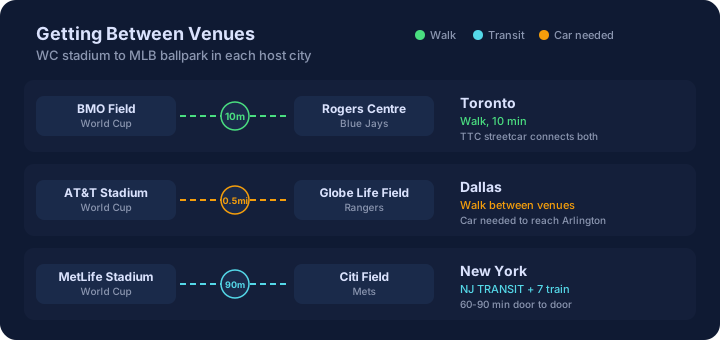
Rule: If one venue is car-dependent, budget $100+ for rideshares over the weekend and do not plan to depart the stadium within 30 minutes of the final whistle, post-match surge pricing is documented at every major NFL/WC venue.
Step 5: What Will It Cost?
Decision question: What is my per-person budget for this trip?
FIFA prices group-stage tickets uniformly at $500 (Category 2 minimum) regardless of venue. The cost differentiator between cities is hotels and transit. Quick benchmarks:
- Budget trip (~$1,474): Dallas, cheapest hotels but car-dependent transit
- Mid-range trip (~$1,578): Toronto, best transit value; jumps to $2,178 for Canada matches
- Premium trip (~$1,924): New York, most flexibility, highest lodging
Rule: If your per-person budget is under $1,600, focus on cities where WC-weekend hotels are under $400/night: Toronto ($393), LA ($378), Dallas ($317), Miami ($392), or Atlanta/San Francisco ($242). The full cost comparison is in the rankings.
Step 6: What If Something Breaks?
Decision question: What happens if my weekend falls apart?
MLB games get rained out. World Cup matches can be rescheduled for broadcast reasons. Flights get delayed.
Rule: Book refundable everything, hotel, flight, and (if possible) World Cup ticket. The cost of refundable bookings is minor compared to being locked into a weekend that no longer works.
Rule: Cities with 4+ stackable weekends give you a backup weekend if your first choice breaks. Cities with only 2 weekends (Dallas, Seattle, Philadelphia, Atlanta) do not, if one is disrupted, your options are thin.
Three Sample Trips
These are complete itineraries assembled from the dataset, the cheapest workable trip, the easiest logistics trip, and the highest-optionality trip.
Cheapest: Dallas, July 3–5 (~$1,474/person)
- Friday July 3, 1:00 PM, WC Round of 32 at AT&T Stadium
- Saturday July 4, 3:05 PM, Tigers at Rangers, Globe Life Field
- Stay: Arlington hotel cluster ($317/night WC median). Walk between both venues.
- Trade-off: No public transit from Dallas proper. Budget $100 for rideshares. Only 2 stackable weekends, no fallback if this one breaks.
Easiest logistics: Toronto, June 12–14 (~$1,578/person, or $2,178 for Canada match)
- Friday June 12, 3:00 PM, Canada vs Bosnia-Herzegovina at BMO Field (WC)
- Saturday June 13, 3:07 PM, Yankees at Blue Jays, Rogers Centre (MLB)
- Stay: Liberty Village or Bloor-Danforth line ($393/night WC median). Walk 10 minutes between venues. UP Express from Pearson Airport.
- Trade-off: Canada match ticket is $1,100 minimum (Cat 2). Neutral-weekend Torontos are $600 cheaper.
Most flexible: New York, June 12–14 (~$1,924/person)
- Friday June 12, 7:15 PM, Braves at Mets, Citi Field (MLB)
- Saturday June 13, 6:00 PM, Brazil vs Morocco, MetLife Stadium (WC)
- Sunday June 14, 1:40 PM, Braves at Mets, Citi Field (MLB)
- Stay: Newark ($300–$400/night, NJ TRANSIT to MetLife and Penn Station). 9 other stackable weekends if this one breaks.
- Trade-off: Highest total cost. 60–90 minute inter-venue transit. Post-match rail congestion at MetLife.
Quick Checklist
- Open the overlap table → pick a city with 4+ weekends
- Book a refundable hotel near the stadium district → today
- Wait for official FIFA ticket sales → do not buy resale yet
- Buy MLB tickets 1–2 weeks before game day
- Use the SportCation trip finder for real-time combinations as the tournament approaches
Don't just watch, Go.
Plan your 2026 World Cup trip
Pick a host city. We'll layer in the MLB, MLS, and stack options.