
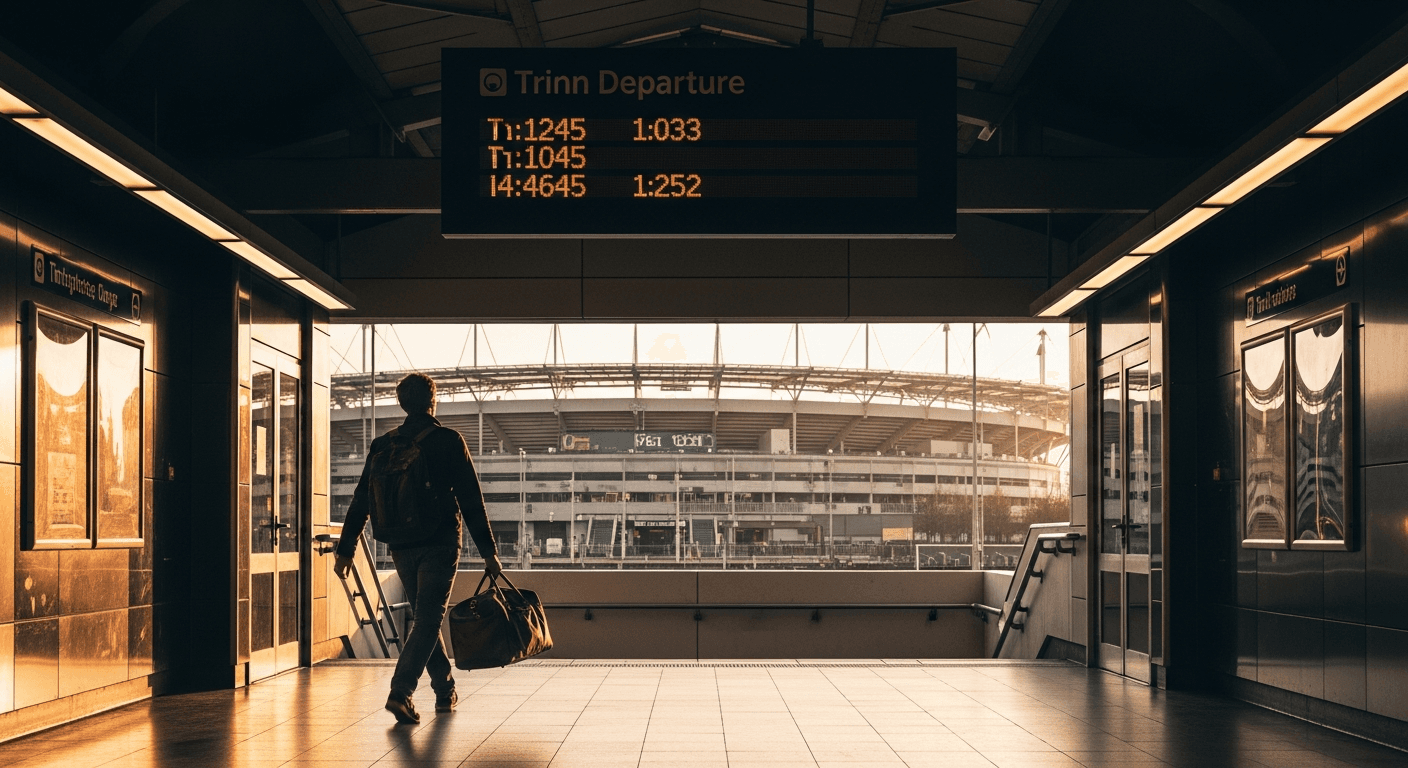
The Airport-to-Arena Sprint: How Fast Can You Get From Baggage Claim to Your Seat?
We timed every major sports city. Some you can make a 7 PM tip-off landing at 5. Others, don't even try.
It's 5:07 PM and you're standing at baggage claim in DCA, watching the carousel spin. The Capitals play at 7. Capital One Arena is fourteen minutes away by Metro. You have time to check into your hotel, grab a beer at Penn Quarter, and still walk through the doors before warmups end.
Now picture the same scenario at JFK. Knicks tip off at 7. You just landed. It's 55 minutes to Madison Square Garden on a good day, and today is not a good day because it's never a good day getting out of JFK. You're watching the game from a bar in Queens.
That gap -- 14 minutes versus 55 -- is the difference between a sportcation that starts at baggage claim and one that starts on the second day. We measured the airport-to-venue transit time for every major sports city in North America, and the spread is staggering. Some cities are practically designed for the fly-in fan. Others seem to be actively working against you.
The Master Ranking
We tracked airport minutes to the main venue cluster for 50+ cities across the U.S. and Canada. "Venue cluster" means the concentration of major pro stadiums and arenas -- not one outlier venue in a suburb 40 miles away. Transit mode is whatever a reasonable person would actually use (rail where it exists, rideshare where it doesn't). Here's how they stack up.
Fastest 20
| Rank | City | Airport | Minutes | Transit Mode | Rail Access |
|---|---|---|---|---|---|
| 1 | San Jose | SJC | 7 | Bus | Rail nearby |
| 2 | Green Bay | GRB | 8 | Car | Bus only |
| 3 | Winnipeg | YWG | 9 | Car | Bus only |
| 4 | Nashville | BNA | 10 | Car | Transfer rail |
| 5 | Santa Clara | SJC | 10 | Car | Rail nearby |
| 6 | Milwaukee | MKE | 13 | Car | Transfer rail |
| 7 | Newark | EWR | 13 | Rail | Rail nearby |
| 8 | San Antonio | SAT | 13 | Car | Bus only |
| 9 | Washington D.C. | DCA | 14 | Rail | Direct rail |
| 10 | Oklahoma City | OKC | 14 | Car | Car dependent |
| 11 | Sunrise (Panthers) | FLL | 14 | Car | Transfer rail |
| 12 | Austin | AUS | 15 | Bus | Direct rail |
| 13 | Charlotte | CLT | 15 | Car | Rail nearby |
| 14 | Columbus | CMH | 15 | Car | Bus only |
| 15 | Inglewood (SoFi) | LAX | 15 | Car | Rail nearby |
| 16 | Las Vegas | LAS | 15 | Car | Rail nearby |
| 17 | Memphis | MEM | 15 | Car | Bus only |
| 18 | Phoenix | PHX | 15 | Rail | Direct rail |
| 19 | Raleigh | RDU | 15 | Car | Transfer rail |
| 20 | Sacramento | SMF | 15 | Car | Rail nearby |
Middle of the Pack
| Rank | City | Airport | Minutes | Transit Mode | Rail Access |
|---|---|---|---|---|---|
| 21 | Tampa | TPA | 15 | Car | Car dependent |
| 22 | Salt Lake City | SLC | 17 | Rail | Direct rail |
| 23 | Arlington (Cowboys) | DFW | 18 | Car | Car dependent |
| 24 | Buffalo | BUF | 18 | Car | Direct rail |
| 25 | Calgary | YYC | 18 | Car | Rail nearby |
| 26 | Orlando | MCO | 18 | Car | Rail nearby |
| 27 | Atlanta | ATL | 20 | Rail | Direct rail |
| 28 | Cincinnati | CVG | 20 | Bus | Bus only |
| 29 | East Rutherford | EWR | 20 | Car | Rail nearby |
| 30 | Jacksonville | JAX | 20 | Car | Rail nearby |
| 31 | New Orleans | MSY | 20 | Car | Bus only |
| 32 | Indianapolis | IND | 22 | Car | Bus only |
| 33 | Anaheim | SNA | 25 | Car | Rail nearby |
| 34 | Vancouver | YVR | 25 | Rail | Direct rail |
The Slowest
| Rank | City | Airport | Minutes | Transit Mode | Rail Access |
|---|---|---|---|---|---|
| 35 | Pittsburgh | PIT | 26 | Car | Direct rail |
| 36 | Cleveland | CLE | 28 | Rail | Direct rail |
| 37 | Edmonton | YEG | 28 | Car | Direct rail |
| 38 | Baltimore | BWI | 28 | Rail | Direct rail |
| 39 | Philadelphia | PHL | 28 | Rail | Direct rail |
| 40 | Boston | BOS | 30 | Rail | Direct rail |
| 41 | Detroit | DTW | 30 | Car | Bus only |
| 42 | Glendale (Cardinals) | PHX | 30 | Car | Car dependent |
| 43 | Houston | HOU/IAH | 30 | Car | Direct rail |
| 44 | Miami | MIA | 30 | Rail | Transfer rail |
| 45 | Minneapolis | MSP | 30 | Rail | Direct rail |
| 46 | Montreal | YUL | 30 | Bus | Transfer rail |
| 47 | Portland | PDX | 30 | Rail | Direct rail |
| 48 | San Diego | SAN | 30 | Bus | Direct rail |
| 49 | St. Louis | STL | 34 | Rail | Direct rail |
| 50 | Kansas City | MCI | 35 | Car | Transfer rail |
| 51 | Seattle | SEA | 35 | Rail | Direct rail |
| 52 | Toronto | YYZ | 35 | Rail | Direct rail |
| 53 | Dallas | DFW | 40 | Car | Transfer rail |
| 54 | Denver | DIA | 42 | Rail | Direct rail |
| 55 | Chicago | ORD | 45 | Rail | Direct rail |
| 56 | Foxborough | BOS | 45 | Car | Direct rail |
| 57 | San Francisco | SFO | 45 | Rail | Rail nearby |
| 58 | Los Angeles | LAX | 50 | Rail | Rail nearby |
| 59 | New York | JFK | 55 | Rail | Direct rail |
The Rail Cities
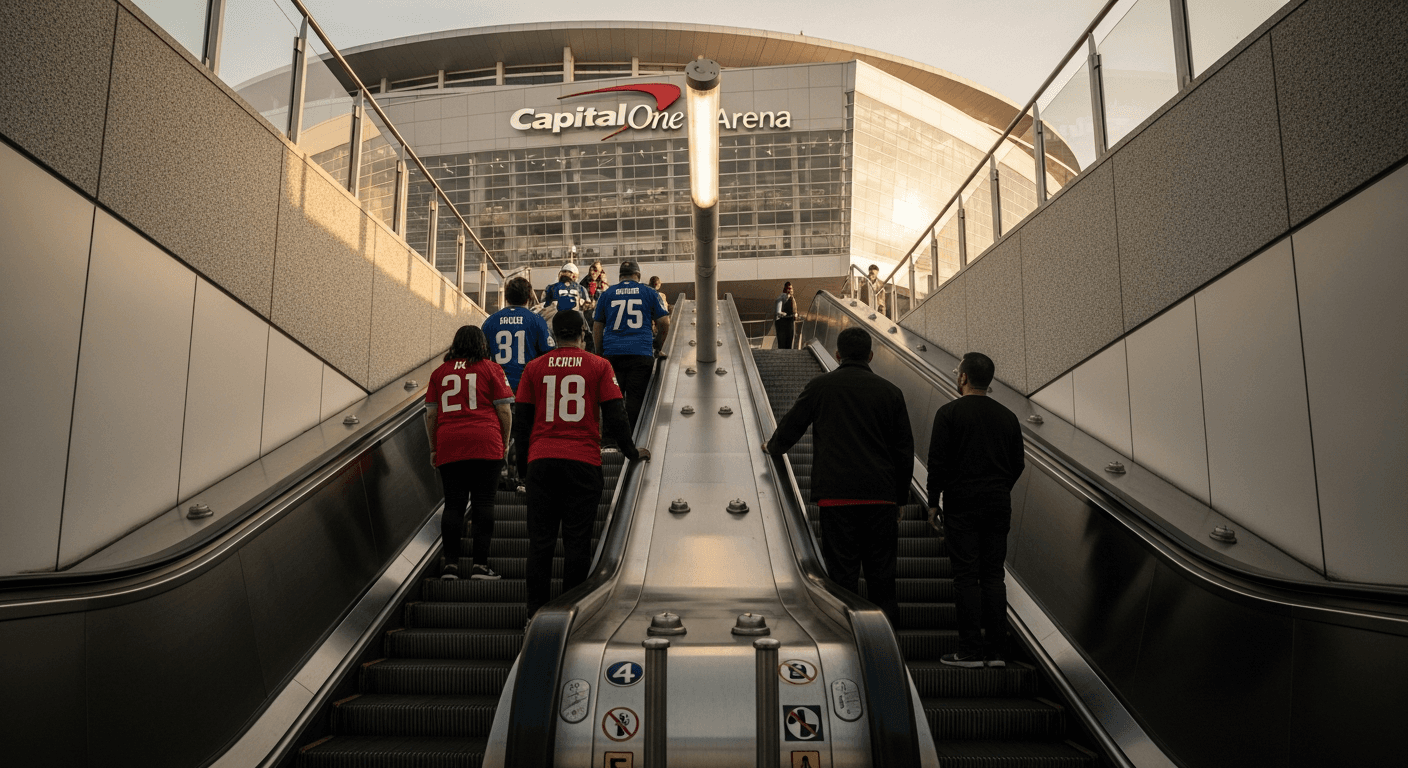
Fourteen minutes. That's how long it takes to get from Reagan National to Capital One Arena on the Metro. You tap your card at the airport station, ride the Blue or Yellow line to Gallery Place, walk up the escalator, and you're staring at the arena entrance. No surge pricing. No driver who wants to take the long way. No praying that I-395 isn't backed up to Springfield.
Washington is the gold standard, but it's not alone. A handful of cities have built what amounts to a direct pipeline from the airport terminal to the seat you're about to sit in.
Atlanta might be the most underrated airport-to-arena connection in the country. MARTA runs from inside the domestic terminal at Hartsfield-Jackson -- literally steps from baggage claim -- to the GWCC/CNN Center station, which spits you out at the doorstep of both Mercedes-Benz Stadium and State Farm Arena. Twenty minutes, total. The fact that ATL is the busiest airport in the world and still manages this is remarkable. It means your Atlanta sportcation starts the moment your wheels touch down.
Phoenix is another one that doesn't get enough credit. Sky Harbor is 3-4 miles from downtown. The free PHX Sky Train connects you to the Valley Metro Rail station, and from there it's a straight shot to Chase Field and the Footprint Center. Fifteen minutes. In a city known for sprawl, the airport-to-arena connection is shockingly good.
Salt Lake City put the TRAX Green Line station right at the airport terminal. Seventeen minutes to Delta Center. No transfer. No shuttle bus to a remote station. Just walk off the plane, grab your bag, and get on a train that drops you at the arena.
Minneapolis runs the METRO Blue Line from MSP directly to downtown. Thirty minutes is longer than the leaders, but you're on a train the entire way, no traffic, no guesswork. Target Center and Target Field are both within walking distance of Blue Line stops.
Denver has the A Line from DIA to Union Station -- 37 minutes on the train, plus a short connection to the venues. At 42 minutes total, it's not fast, but it's reliable, and reliable beats fast-but-stuck-on-I-70 every time. The RTD system connects Union Station to Ball Arena, Coors Field, and Empower Field at Mile High, all within a few minutes of each other. If you're headed to Denver for a three-sport weekend, that single train from the airport is the start of everything.
Chicago is an interesting case. The CTA Blue Line from O'Hare to downtown is genuinely good transit infrastructure. But 45 minutes is 45 minutes, and if you're connecting to the United Center or Wrigley Field from the Loop, add another 15-20 on top of that. It's one of the best rail systems in North America and still takes an hour to actually reach your seat. From Midway, the Orange Line is faster to downtown, so if you're flying Southwest, that's worth knowing.
The 5 PM Landing Test
Here's the scenario that matters most to the fly-in sports fan. Your flight touches down at 5 PM. The game starts at 7. Can you make it?
You need to account for deplaning (10 min), baggage claim (15 min if you're lucky, 25 if you checked a bag at JFK), getting to your transit mode (5-10 min), and the actual travel time. If you haven't checked a bag, you buy back 15 minutes. That matters more than you'd think.
Cities where you can absolutely make it (carry-on only):
Washington D.C., Phoenix, Salt Lake City, Atlanta, Austin, Nashville, San Jose, Las Vegas, Milwaukee, Charlotte, Columbus, Tampa, Sacramento, Oklahoma City, Memphis, Raleigh, Green Bay, Winnipeg, San Antonio, Inglewood, Buffalo, Orlando, Arlington, and Calgary. All of these are under 25 minutes from airport to venue cluster, which leaves you at least 50 minutes of buffer after deplaning. That's enough time to drop your bag at a hotel and still be in your seat for the anthem.
Cities where it's tight but doable:
Anaheim, Vancouver, Cleveland, Pittsburgh, Baltimore, Philadelphia, Edmonton, and Indianapolis. You're in the 22-28 minute range. With a carry-on and no hotel stop, you can make tip-off. With a checked bag, you're cutting it razor-thin. Skip the hotel. Go straight to the arena. Deal with your luggage later.
Cities where you're sweating:
Boston, Minneapolis, Houston, Portland, Miami, Montreal, Detroit, San Diego, and St. Louis. These are all 30-34 minutes to the venue, meaning your total transit time from wheels down is pushing 55-65 minutes. Possible if everything goes right. Rare that everything goes right.
Cities where you need to land earlier:
Kansas City, Seattle, Toronto, Dallas, Denver, Chicago, San Francisco, Los Angeles, Foxborough, and New York. If you're landing at 5 for a 7 PM game in any of these cities, you're watching the first quarter from a bar. New York at 55 minutes from JFK means your realistic arrival time at MSG is somewhere around 6:30 if every connection is perfect and you have no luggage. It won't be and you do.
The Worst Cases
Some cities aren't just slow -- they're structurally hostile to the fly-in fan.
Foxborough is the hardest sports destination to reach from an airport in the entire dataset. Gillette Stadium is 45 minutes from Logan on a good traffic day, and there is no good traffic day when the Patriots are playing. The special "Patriot Train" from South Station helps if you're already in Boston, but from the airport you still need to get to South Station first. If you're doing a Boston sportcation, plan your Foxborough day around an early arrival. Do not try to land and race to Gillette.
New York has three airports and none of them are fast. JFK is 55 minutes. LaGuardia has no rail connection at all -- you're in a car, in traffic, praying. Newark is 13 minutes to the Prudential Center in Newark itself, but if you're trying to get to Manhattan, add 30-40 more. The subway system is the best in the country once you're in it, but getting from any airport to the subway system is where the plan falls apart.
Los Angeles at 50 minutes from LAX is partly a distance problem and partly an LA problem. The Metro does connect LAX to downtown now, which is a massive improvement from five years ago, but it's still a 50-minute trip to Crypto.com Arena. If you fly into Burbank instead, you can cut 15-20 minutes off that, and Burbank is a far more pleasant airport experience anyway.
The Canadian Angle
Four Canadian cities land in our data: Toronto, Vancouver, Calgary, and Edmonton. Plus Winnipeg, which deserves its own sentence for being nine minutes from the airport to Canada Life Centre, which is faster than most American cities manage.
Vancouver is the standout. The Canada Line SkyTrain runs directly from YVR to downtown, with BC Place and Rogers Arena both within walking distance of SkyTrain stations. Twenty-five minutes, reliable, no car needed. There's a $5 YVR AddFare surcharge on top of the regular transit fare for trips originating at the airport, which is mildly annoying but ultimately trivial. Vancouver's transit connection to its sports venues is better than most U.S. cities with twice the population.
Toronto takes 35 minutes via the UP Express from Pearson to Union Station, and from there you're practically on top of Scotiabank Arena and the Rogers Centre. The UP Express runs every 15 minutes during peak hours and costs around C$13. It works well, but 35 minutes isn't fast. If you fly into Billy Bishop Toronto City Airport instead, you're downtown in 10 minutes via the pedestrian tunnel -- but Billy Bishop only serves limited domestic routes.
Calgary and Edmonton are both car-dependent from their airports. Calgary is 18 minutes by taxi to the Scotiabank Saddledome; no CTrain connection from YYC exists yet. Edmonton is 28 minutes from YEG, with the LRT available downtown but a bus-then-transfer setup from the airport that most people skip in favor of a cab. Neither is terrible, but neither is the kind of seamless train-to-arena pipeline that makes Vancouver or Washington feel purpose-built for fans.
Making It Work
The actual hack for the airport-to-arena sprint isn't about which city you pick. It's about how you pack and when you book.
Carry-on only is the single biggest time-saver. In our estimates, checked baggage adds 15-20 minutes to every arrival. That's the difference between making the game and missing the first period in about a dozen cities. If you can fit a weekend into a carry-on, do it. If you can't, ship your bag ahead or check it and accept that you're not making a 7 PM start on a 5 PM landing.
Flight timing matters more than flight price. A 3 PM arrival gives you margin in every single city on this list, including New York. A 5 PM arrival works in about half of them. A 6 PM arrival works in maybe 10. When you're booking, sort by arrival time, not departure time. The hour you save by taking an earlier flight is worth more than the $40 you save on a later one.
And know your transit before you land. Download the local transit app the day before. Know which train line you need. Know which terminal exit gets you to the rail station fastest. In Atlanta, that means walking to the MARTA station inside the terminal, not wandering out to the rideshare curb. In Denver, that means following signs to the A Line platform, not the taxi stand. Five minutes of preparation the night before saves fifteen minutes of confusion when your phone is at 12% and you can hear the crowd from outside the arena.
The cities that rank at the top of this list -- Washington, Atlanta, Phoenix, Salt Lake City -- didn't get there by accident. They built transit connections that treat the airport as the front door to the sports district. The cities at the bottom -- New York, LA, Chicago -- have world-class venues and world-class transit systems that somehow never quite connect to the airport efficiently. The infrastructure is there. The last mile just isn't.
We built SportCation around the idea that the best sports weekends start with smart logistics. The airport-to-arena sprint is the first test. If you pick the right city, you pass it before you've even opened your rideshare app.
Don't just watch, Go.